Unsere Substrate werden FRISCH für Sie produziert, deshalb beträgt die Produktionszeit ca. 3 - 6 Wochen.
Mehr kaufen, mehr sparen - entdecken Sie unsere Mengenrabatte! (spätestens ersichtlich im Warenkorb!)
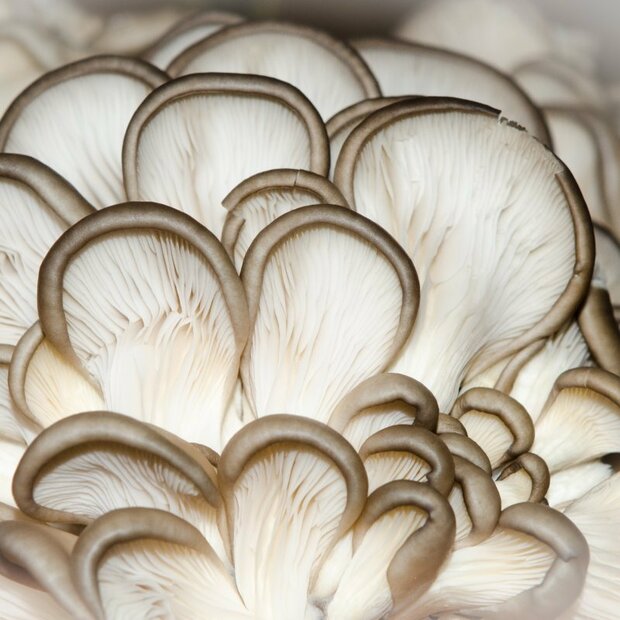
Bio-Lungenseitling - Pleurotus pulmonarius - Pilzbeet
für die biologische Pilzzucht
Mengenrabatt:
ab 3 Stk.
ab 6 Stk.
ab 30 Stk.
ab 100 Stk.
Bio-Lungenseitling - Pleurotus pulmonarius - Pilzbeet
Synonyme: Sommer-Austernpilz, indischer Austernpilz, Phoenix Pilz, Dhingri
Der Lungenseitling zeichnet sich durch eine große Vielfalt an Varianten aus, er ist sehr leicht zu kultivieren und bietet den Kultivatoren eine reichhaltige Ressource für neue Stämme. Der Fruchtkörper erreicht einen Durchmesser von 5 bis 20 cm. Der Hut ist grau-weiß bis beige und zartlila-gräulich. Geschmack, Haltbarkeit und Zubereitung in der Küche sind vergleichbar mit dem "normalen" Austernpilz, wobei der Lungenseitling bei wärmeren Temperaturen fruchtet und sich daher bestens für den Anbau während der wärmeren Jahreszeiten anbietet.
Diese Frischware wird auf Bestellung frisch für Sie angesetzt. Die Produktionszeit beträgt rund 3 - 6 Wochen.
Die Pilzbrut sollte sofort nach der Lieferung verarbeitet werden.
Sollte das Produkt nicht sofort verarbeitet werden können, kann es bis zu 2 Wochen im Kühlschrank bei 4 °C gelagert werden.
Wir empfehlen, dies bei der Bestellung und Ihren Vorbereitungen gemäß Anleitung einzuplanen.
Geeignete Anbaumethoden:
Strohballen, Baumstämme, Pilzbeet
- auch für die Mykorestaurierung, Fertigkultur im Gewächshaus
Geeignetes Substrat: Stroh, Papier, Kaffeesatz, Fruchtfleisch von Kaffeebohnen, Laubholz
Geeignete Hölzer sind Pappel, Eiche, Erle, Espe, Ahorn, Birke, Esche, Buche, Weide oder Ulme.
Dieser Zuchtstamm fruchtet beim Freilandanbau mehrmals im Spätsommer bis frühen Herbst.
Sie erhalten fertig von Pilzmyzel besiedelte Pilzbrut auf Basis biologischer Rohstoffe (Holz, Roggenkleie aus Bio-Anbau)
in speziell für die Sterilisation geeigneten Säcken.
Je nach Pilzart sind sie folgendermaßen erhältlich und zu verarbeiten:
1 Autoklav-Bag mit ca. 1 Liter (500 Gramm) eignet sich
zum Beimpfen und
für die Vermehrung über 4 - 8 Wochen in sterilisiertem Holzsubstrat vor dem Beimpfen des Pilzbeets (siehe Anleitung).
1 Autoklav-Bag mit ca. 6 Litern Pilzbrut eignet sich für das Beimpfen eines Pilzbeets mit 80 x 80 cm.
Mykorestaurierung mittels Pilzbeet:
Einige
Pilzgattungen eignen sich dazu, diese Giftstoffe abzubauen und aus der Umwelt
zu entfernen.
Dazu wird Pilzmyzel von entsprechenden Pilzsorten im kontaminierten Boden
verteilt und mit geeignetem Nährboden vermischt, um eine großflächige
Abdeckung der Schadstoffquelle zu erreichen. Die Myzelstränge
durchwachsen den Boden. Sie nehmen einzelne Giftstoffe direkt auf bzw.
zerlegen diese in ihre Bestandteile und machen sie so unschädlich.
Der Pilz nimmt die Giftstoffe in seine Fruchtkörper auf. Diese müssen nach Abschluß des Lebenszyklus geerntet und fachgerecht entsorgt werden.
Die Einsatzgebiete
dieser Pilzart sind:
- Schwermetalle wie Cadmium, Kupfer und Quecksilber
- Dioxin, auch Sevesogift genannt, das lange Zeit massiv als Unkrautvernichtungsmittel eingesetzt wurde,
- Trinitrotoluol (TNT) aus militärischer Munition wie Bomben, Granaten und Minen,
- Bakterien wie Escherichia coli sowie andere Stämme.
Quellen:
STAMETS, La Dena Che’. Best Mycorestoration Practices for Habitat Restoration of Small Land Parcels. 2012.
STAMETS, Paul. Mycelium running: how mushrooms can help save the world. Ten speed press, 2005, S. 85 - 113.
Taxonomie:
Klasse: Agaricomycetes
Unterklasse: Agaricomycetidae
Ordnung: Champignonartige (Agaricales)
Familie: Seitlingsverwandte (Pleurotaceae)
Gattung: Seitlinge (Pleurotus)
Art: Lungenseitling (Pleurotus pulmonarius)
Sporen: meist weiß bis gelblich, grau, 7,5 - 11 x 3 - 4 µ, Schnallen sind vorhanden
Zuchtbedingungen:
Phase 1: Myzelwachstum
Temperatur: 24 - 29 °C
Luftfeuchte: 90 - 100 %
Dauer: 8 - 14 Tage
CO2: > 5.000 ppm
Raumluftwechsel: 1 pro Stunde
Licht: n/a
Phase 2: Primordia Bildung / Einleitung der Fruchtung
Temperatur: 10 - 24 (27) °C
Luftfeuchte: 95 - 100 %
Dauer: 3 - 5 Tage
CO2: 400 - 800 ppm
Raumluftwechsel: 5 - 7 pro Stunde
Licht: 1.000 - 1.500 (2.000) Lux
Phase 3: Fruchtung und Ernte
Temperatur: 18 - 24 °C
Luftfeuchte: 85 - 90 %
Dauer: 3 - 5 Tage
CO2: 400 - 800 ppm
Raumluftwechsel: 5 - 7 pro Stunde
Licht: 1.000 - 1.500 (2.000) Lux
Ernte: alle 7 - 10 Tage in 3 Erntewellen