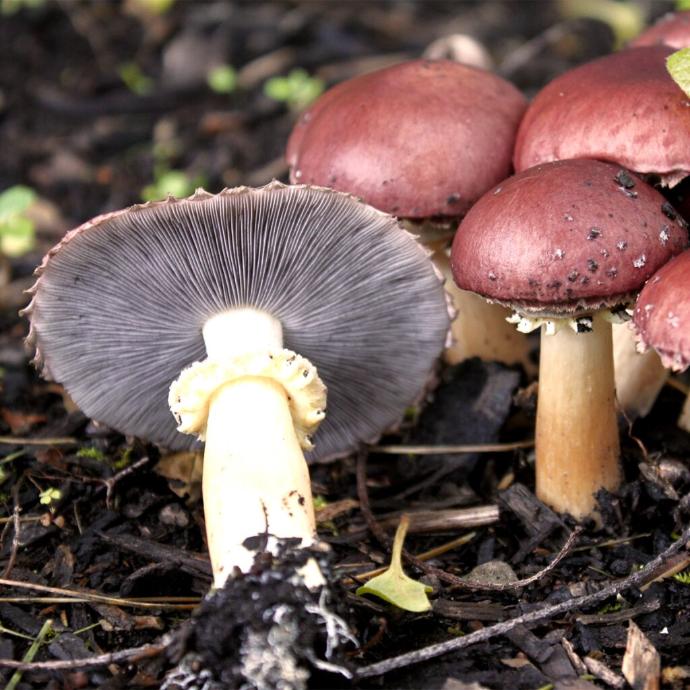
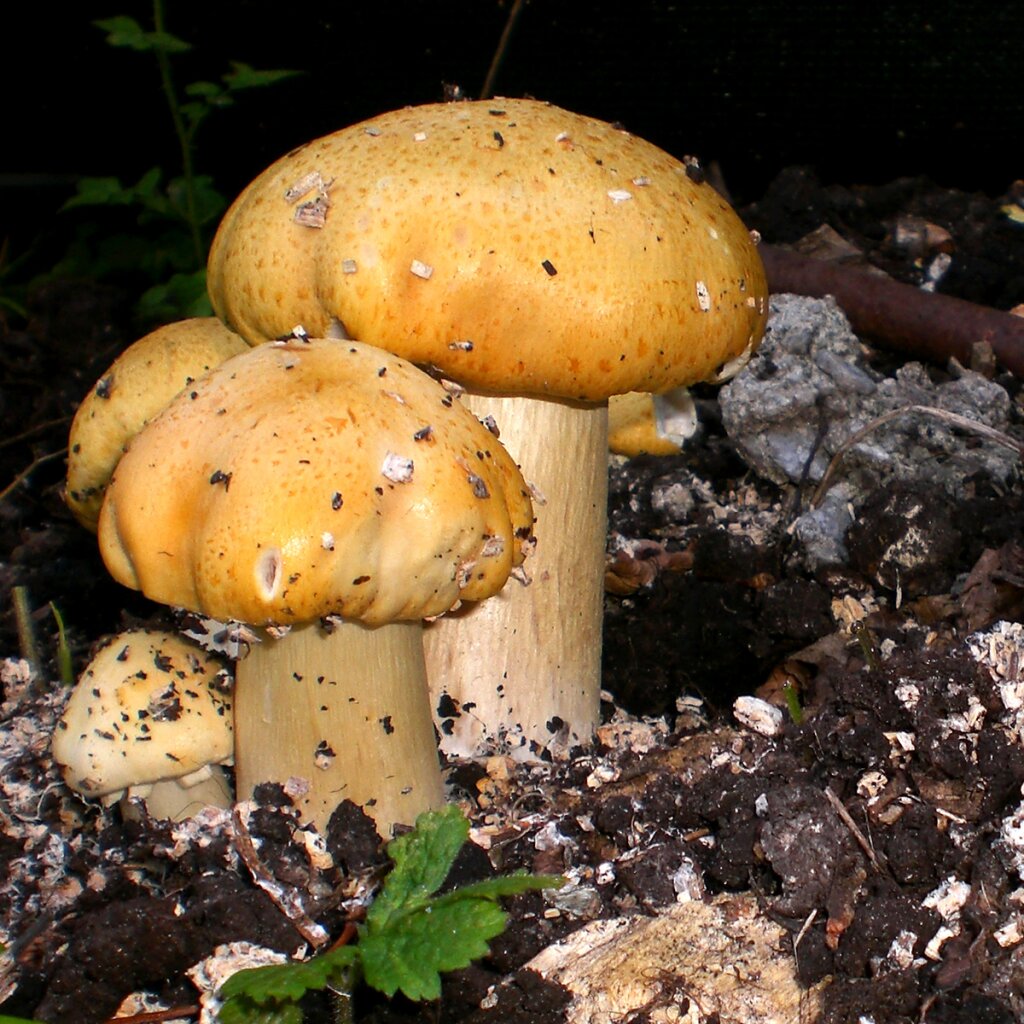
King Stropharia
Various strains available
Scientific name: Stropharia rugosoannulata
Synonyms: Wine Cap, King Stropharia, Garden Giant, Burgundy mushroom, Wine-red Stropharia
Distribution and habitat in nature: It is a saprobiont, a secondary decomposer. Belonging to the group of nematophagous fungi, it also feeds carnivorously on nematodes/roundworms.
It is found in nutrient-rich locations such as ruderal sites, gardens, parks, road embankments, and roadsides. The fruiting bodies appear in Central Europe in spring and fall.
Ingredients: It is rich in protein and contains B vitamins (especially B2 and B3), potassium, iron, and magnesium. It also provides fiber, and the antioxidant effect of its ingredients is remarkable.
Suitable substrate: Mushroom compost, straw, wood chips
Usage: Edible mushroom, medicinal and vital mushroom, mycorestauration/mycoremediation
In the kitchen, the garden giant is prized for its mild, nutty flavor, which is reminiscent of red wine or potatoes when roasted. It is relatively easy to grow in gardens and on wood mulch—hence its name. It is rich in protein and is an excellent regional, sustainable meat substitute in vegetarian cuisine.
Taxonomy:
Kingdom: Fungi
Class: Agaricomycetes
Subclass: Agaricomycetidae
Order: Agaricales
Family: Strophariaceae
Genus: Stropharia
Species: Stropharia rugosoannulata
Spores: purple-brown, 11–13 x 7.5–8 µ, smooth, ellipsoid. Clamp connections are present.
Breeding conditions:
Phase 1: Mycelium growth
Temperature: 21-27°C
Humidity: 95-100%
Duration: 25-45 days
CO2: >20,000 ppm
Air exchange: 0-1 per hour
Light: n/a
Phase 2: Primordia formation / initiation of fruiting
Temperature: 10-16°C
Humidity: 95-98%
Duration: 14 - 21 days
CO2: <1,500 ppm
Room air exchange: 4 - 8 per hour
Light: 100 - 500 lux
Phase 3: Fruiting and harvest
Temperature: 16 - 21°C
Humidity: 85 - 95%
Duration: 7 - 14 days
CO2: <1,500 ppm
Room air exchange: 4 - 8 per hour
Light: 100 - 500 lux
Harvest waves: two harvest waves at intervals of 3-4 weeks