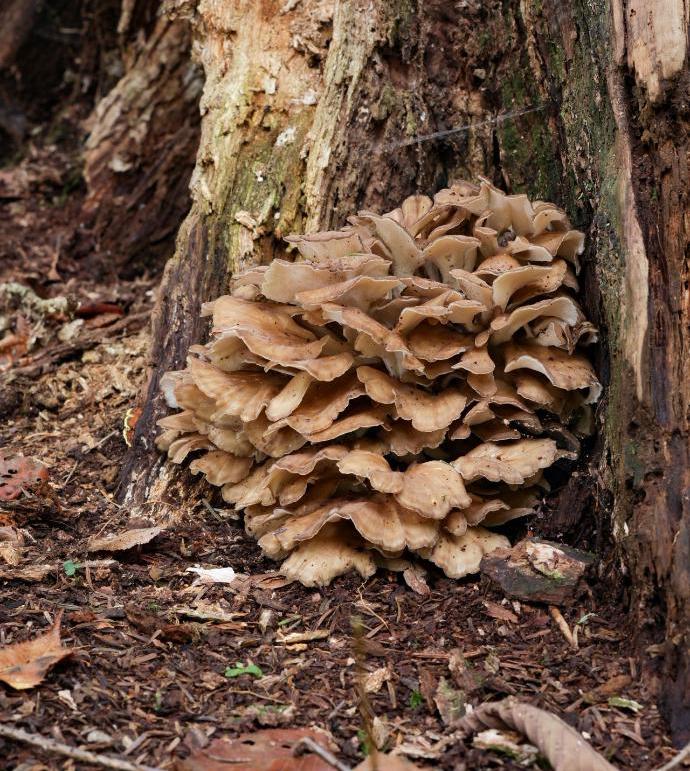
Maitake
Scientific name: Grifola frondosa
Synonyms:
Hen of the Woods, Sheep’s Head, Ram’s Head, Dancing Mushroom
Distribution and habitat in nature: Maitake mushrooms are mainly found on stumps or at the base of dead or dying deciduous trees such as oak, elm, maple, birch, and sometimes larch. In isolated, very rare cases, maitake mushrooms have also been found on pine trees.
Ingredients: The mushroom contains many polysaccharides such as beta-glucan, grifolin, and grifolan, as well as large amounts of ergosterol and provitamin D.
Suitable substrate:
Hardwood (particularly suitable: oak, beech, plum, chestnut, maple, elm, alder, birch)
Usage:
Edible mushroom, medicinal mushroom
The Maitake is known in Asia and Europe and America as a delicious, meaty edible mushroom that is characterized by its high nutritional value and medicinal properties. As a result, this mushroom has also attracted considerable interest in the pharmaceutical industry and has been considered a valuable subject of research in Korean, Japanese, and American studies for several years.
Taxonomy:
Class: Basidiomycetes
Subclass: Agaricomycetidae
Order: Polyporales
Family: Meripilaceae
Genus: Grifola
Species: Grifola frondosa
Spores: white, slightly elliptical, smooth and glassy; 6 - 7 x 3.5 - 5 µm
Breeding conditions:
Phase 1: Mycelium growth
Temperature: 21–24°C
Humidity: 95–100%
Duration: 14–30 days
CO2: 20,000–40,000 ppm
Air exchange: 0–1 per hour
Light: n/a
Phase 2: Primordia formation
Temperature: 10 - 15.6 °C
Humidity: 95%
Duration: 5 - 10 days
CO2: 2,000 - 5,000 ppm
Air exchange rate: 4 - 8 per hour
Light: 100 - 500 lux
Phase 2: “Wedel” formation
Temperature: 10 - 15.6 °C
Humidity: 90 - 95%
Duration: 10 - 14 days
CO2: 2,000 - 5,000 ppm
Room air exchange: 4 - 8 per hour
Light: 100 - 500 lux
Phase 3: Fruiting and harvesting
Temperature: 13–16 (18)°C
Humidity: 75–85%
Duration: 14–21 days
CO2: <1,000 ppm
Air exchange rate: 4–8 per hour
Light: 500–1,000 lux
Harvest waves: 2 harvest waves at intervals of 3-4 weeks