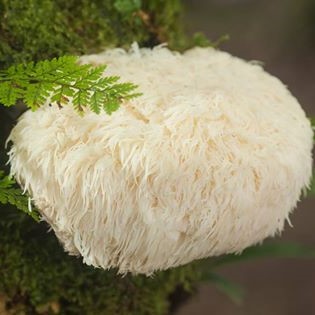
Lion's Mane
Scientific name: Hericium erinaceus
Synonyms: Monkey head, Yamabusitake, Pom-Pom
blanc, hóu tóu gu, nam dau khi,
Norugongdengi-beoseot
Distribution and habitat in nature:
The Lion´s mane prefers to grow on hardwoods such as oak, walnut, beech, maple, and plane tree. In the wild, this mushroom can be found in late summer and fall in Europe, North America, and Asia (especially China and Japan) in deciduous forests.
Ingredients: The Lion´s Mane is rich in potassium, zinc, iron, germanium, selenium, phosphorus, and contains all essential amino acids as well as polysaccharides and polypeptides. What is particularly interesting about this mushroom is its content of specific ingredients, including the diterpenes erinacin and hericenone.
Suitable substrate: Hardwood (particularly suitable: oak, beech, walnut, birch, maple)
Usage: Edible mushroom, medicinal mushroom
The Lion´s mane is considered a popular and exquisite edible mushroom in China. It is one of the few mushrooms that has a strong lobster aroma when cooked. In Europe, the hedgehog mushroom is not very well known, even though it is native to parts of the continent.
Its unique taste and extremely decorative, coral-like appearance make it a sought-after delicacy.
Taxonomy:
Kingdom: Fungi
Class: Basidiomycetes
Subclass: Agaricomycetidae
Order: Russulales
Family: Hericiaceae
Genus: Hericium
Species: Hericium erinaceus
Spores: white, elliptical, smooth to slightly rough; 5.5–7 x 4.5–5.5 µ
Cultivation Conditions:
Phase 1: Mycelium Growth
Temperature: 21-24°C
Humidity: 95-100%
Duration: 10-14 days
CO2: >5,000 - 40,000 ppm
Air Exchange Rate: 0-1 per hour
Light: n/a
Phase 2: Primordia Formation / Initiation of Fruiting
Temperature: 10 - 15.6°C
Humidity: (85) 90 - 95%
Duration: 4-5 days
CO2: 500 - 1000 ppm
Air Exchange Rate: 5-8 per hour
Light: 500 - 1,000 Lux
Phase 3: Fruiting and Harvest
Temperature: 18 - 24°C
Humidity: (85) 90 - 95%
Duration: 4-5 days
CO2: 500 - 1000 ppm
Air Exchange Rate: 5-8 per hour
Light: 500 - 1,000 Lux