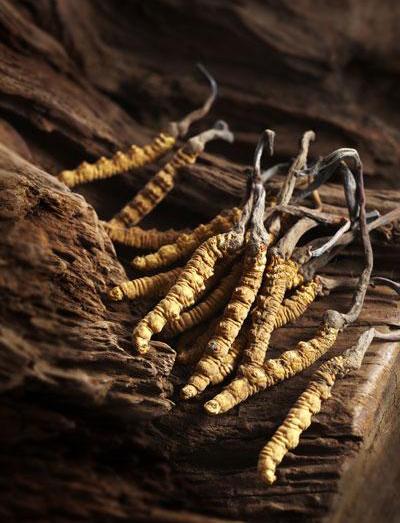
Caterpillar Fungus
Scientific name: Cordyceps sinensis
Synonyms: Ophiocordyceps sinensis, Chinese caterpillar mushroom, Tibetian caterpillar fungus, yartsa gunbu, yatsa gunbu, yarshagumba, yarchagumba, chong cao
Distribution and habitat in nature: It grows exclusively on caterpillars of the genus Thitarodes in the high plateaus of Tibet between 3,000 and 5,000 m.
Ingredients: Scientists of our time have analyzed its ingredients and confirmed numerous effects. In addition to vitamins and trace elements, the caterpillar fungus contains essential amino acids and high-quality polysaccharides. Ingredients such as cordycepin, ophicordin, and galactomannan also make this fungus so incredibly interesting.
Suitable substrate: Dried silkworms, plant substrate
Usage: Medicinal mushroom
Athletes use this mushroom because it is not banned as a doping agent. Athletes in Asian cultures have long used cordyceps to increase energy and endurance. In 1993, five world records in running events were broken by the same team at the Chinese National Championships in Beijing. When asked by reporters, Ma Junren, the team's coach, revealed that his athletes owed their strength and endurance to the cordyceps mushroom.
The effects of these mushrooms that are of interest to humans are documented in Chinese herbal books that are up to 2,000 years old. Cordyceps species, especially C. sinensis and C. militaris, are said to strengthen the life energy “Qi.”
The genetic profile of our Cordyceps corresponds exactly to that of the wild variety and it is cultivated under conditions that it also finds in its natural habitats.
Taxonomy:
Kingdom: Fungi
Class: Sordariomycetes
Subclass: Hypocreomycetidae
Order: Hypocreales
Family: Ophiocordycipitaceae
Genus: Ophiocordyceps