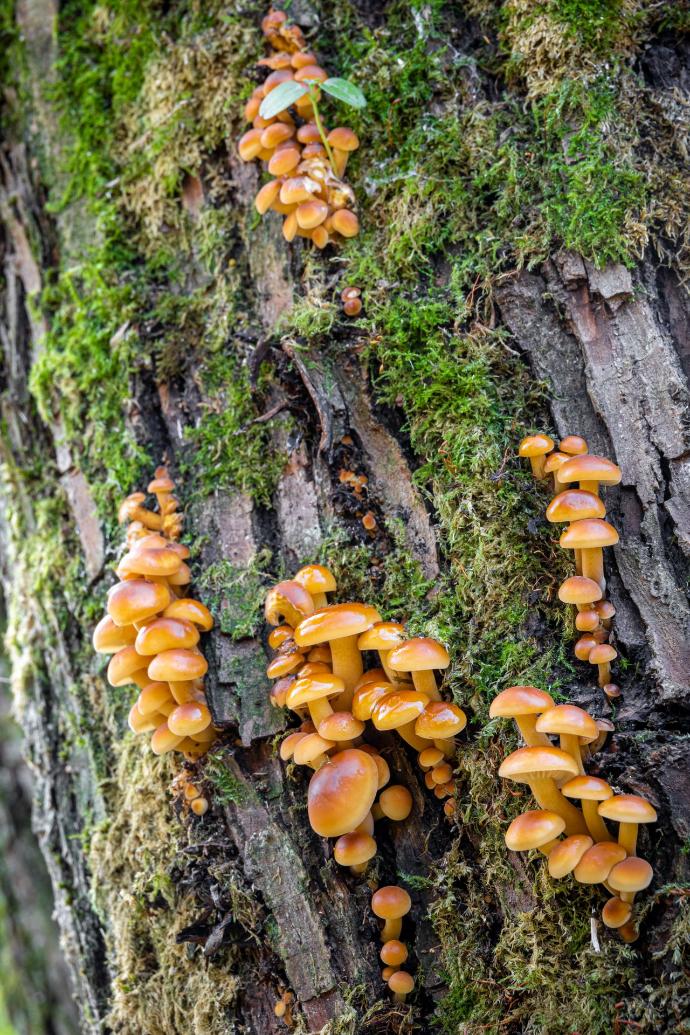
Winter Mushroom
Scientific name: Flammulina velutipes
Synonyms: Enokitake, Enoki Mushroom, Jīnzhēn Gū, Nametake
Distribution and habitat in nature: This mushroom is found worldwide. The Winter Mushroom prefers deciduous woodland habitats, and in Europe its fruiting bodies can be found from late fall to winter, which is why it is also known as the winter mushroom in some regions. It can also survive slight sub-zero temperatures and night frosts; the fruiting bodies freeze and continue to grow after thawing.
Ingredients: The Winter Mushroom is a low-calorie but nutrient-rich edible mushroom. It contains valuable protein, fiber, and vitamins such as B1, B2, B3, and folic acid. It also provides important minerals such as potassium, iron, and phosphorus. Bioactive ingredients such as polysaccharides and antioxidants can support the immune system and have anti-inflammatory effects.
Suitable substrate: Hardwood (particularly suitable: oak, alder, poplar, aspen, willow, birch, beech)
Usage: Edible mushroom
The Winter Mushroom is an edible mushroom that is particularly popular in Asia, with small but very tasty fruiting bodies.
Enokitake cultivation has a long tradition in China and was first documented around 800 AD. At that time, ripe fruiting bodies were rubbed on tree stumps. Often, a rich harvest could be reaped in these places the following year. Of course, the method commonly used today with dowel spawn is more successful.
Taxonomiy:
Kingdom: Fungi
Class: Agaricomycetes
Subclass: Agaricomycetidae
Order: Agaricales
Family: Physalacriaceae
Genus: Flammulina
Species: Common velvet foot mushroom
Spores: white, ellipsoidal in shape, between 6-8 x 3-4 µ in cultivated forms and between 8-9 x 4.5-6 µ in wild European varieties.
Breeding conditions:
Phase 1: Mycelium growth
Temperature: 21–24 °C
Humidity: 95–100%
Duration: 14–18 days
CO2: >5,000 ppm
Air exchange: 0–1 per hour
Light: n/a
Phase 2: Primordia formation / initiation of fruiting
Temperature: 4 - 10°C
Humidity: 95 - 100%
Duration: 3 - 5 days
CO2: 2,000 - 4,000 ppm
Room air exchange: 2 - 4 per hour
Light: 20 - 50 lux
Phase 3: Fruiting and harvesting
Temperature: 10–16°C
Humidity: 90–95%
Duration: 5–8 days
CO2: 2,000–4,000 ppm
Air exchange: 2–4 per hour
Light: 20–50 lux