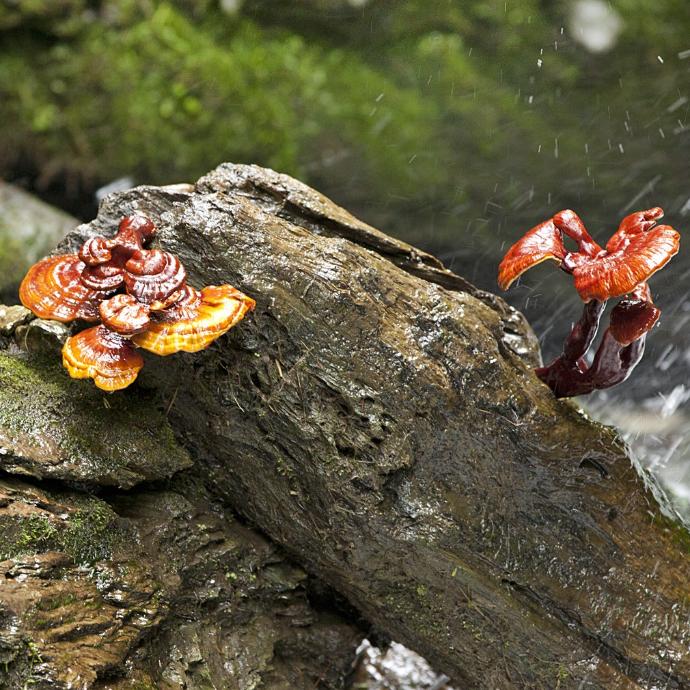
Reishi
Various strains available
Scientific: Ganoderma lucidum
Synonyms: Ling Zhi, Jong Si, Shiny Ganoderma, Mannentake, Ten-Thousand-Year Mushroom, Immortality Mushroom, Herb of Spiritual
Distribution and Habitat: The Reishi is a wood-decomposing saprophyte that primarily colonizes broadleaf trees such as oaks, beeches, alders, and birches. It prefers warm oak or mixed oak forests, but can also be found in beech forests and hardwood riparian zones. Additionally, it can be found in hedges, parks, and along roadsides if the conditions are suitable. It is widely distributed in Mediterranean and temperate regions and can be found as far north as southern Scandinavia. In Germany and Austria, the Shiny Ganoderma is variably distributed across the entire region.
Ingredients: The Reishi is rich in micronutrients such as iron, magnesium, calcium, zinc, copper, manganese, and germanium. Particularly valuable are the polysaccharides and triterpenes found in Reishi, including ganoderic acids, ganolucia acids, and lucidemic acids.
Suitable Substrate: Broadleaf wood (especially oak, alder, beech, birch)
Usage: Medicinal mushroom, healing mushroom
This mushroom is known as Ling Zhi in China and Reishi in Japan. It is believed to have a history of about 4,000 years! In East Asia, the Reishi traditionally symbolizes health, physical and mental recovery, longevity, high sexual vitality, wisdom, and wealth.
Taxonomy:
Kingdom: Fungi
Class: Basidiomycetes
Subclass: Polyporales
Order: Ganodermataceae
Family: Ganoderma
Genus: Shiny Ganoderma
Spores: Reddish-brown, ellipsoid with blunt ends, 9-12 × 5.5-8 u
Cultivation Conditions:
Phase 1: Mycelium growth
Temperature: 21–27 °C
Humidity: 95–100%
Duration: 10–20 days
CO2: Tolerates up to 50,000 ppm or 5%
Air exchange: 0–1 per hour
Light: Not applicable
Phase 2: Primordia formation/start of fruiting
(For antler shape – cultivation in closed bags)
Temperature: 18–24 °C
Humidity: 95–100%
Duration: 14–28 days
CO2: 20,000–40,000 ppm
Air exchange: 0–1 per hour
Light: 200–500 lux for 4–8 hours per day
Phase 2: Primordia formation/start of fruiting
(For cap shape – cultivation in open bags)
Temperature: 21–27 °C
Humidity: 95–100%
Duration: 14–28 days
CO2: 5,000–2,000 ppm
Air exchange: according to the desired CO2 content
Light: 750–1,500 lux for 12 hours per day
Phase 3: Fruit formation and harvest
Temperature: 21–27 °C
Humidity: 90–95%
Duration: 60 days
CO2: <2,000 ppm
Air exchange: according to the desired CO2 content
Light: 750–1,500 lux