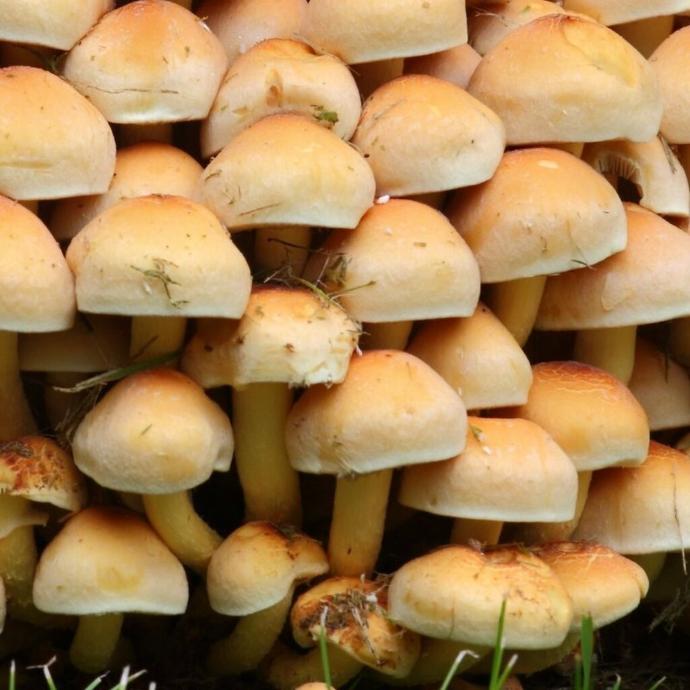
Brown Gilled Woodlover
Scientific name: Hypholoma capnoides
Synonyms: Conifer Tuft, Smoky Gilled Woodlover, Clustered Woodlover
Distribution and habitat in nature: This mushroom is a saprobiont, a secondary decomposer. The grey-leaved sulphur head is widespread in the Holarctic region. Europe, North America and Asia. It can be found in almost all forest communities, mostly on rotting coniferous wood, less frequently on deciduous wood. The fruiting bodies appear in Central Europe in dense clusters, mainly from September to November. Another peak growth period is usually in April. In suitable weather conditions, it can be found all year round.
Suitable substrate: Softwood (spruce, fir, Douglas fir, pine), rarely also hardwood (beech, birch)
Usage: edible mushroom
The Brown Gilled Woodlover is an edible mushroom with a mild nutty taste that is well suited for mushroom dishes; it provides protein, fiber, minerals (especially potassium and phosphorus), B vitamins, and has antioxidant properties due to secondary plant substances, but requires special care when collecting due to the risk of confusion with poisonous species.
Taxonomiy:
Kingdom: Fungi
Class: Agaricomycetes
Subclass: Agaricomycetidae
Order: Agaricales
Family: Strophariaceae
Genus: Hypholoma
Species: Hypholoma capnoides (Hypholoma capnoides)
Spores: purple to brown, elongated ellipsoid, 7 - 9 × 4 - 5 µ
Breeding conditions:
Phase 1: Mycelium growth
Temperature: 21–24°C
Humidity: 95–100%
Duration: 20–28 days
CO2: > 10,000 ppm
Air exchange: 0–1 per hour
Light: n/a
Phase 2: Primordia formation / initiation of fruiting
Temperature: 7–13°C
Humidity: 98–100%
Duration: 10 - 14 days
CO2: 1,000 - 2,000 ppm
Room air exchange: 1 - 2 per hour
Light: 200 - 500 lux
Phase 3: Fruiting and harvest
Temperature: 10 - 16°C
Humidity: 90–95%
Duration: 10–14 days
CO2: 1,000–5,000 ppm
Air exchange: 1–2 per hour
Light: 200–500 lux
Harvest waves: 1 to 2 harvests at 4-week intervals.