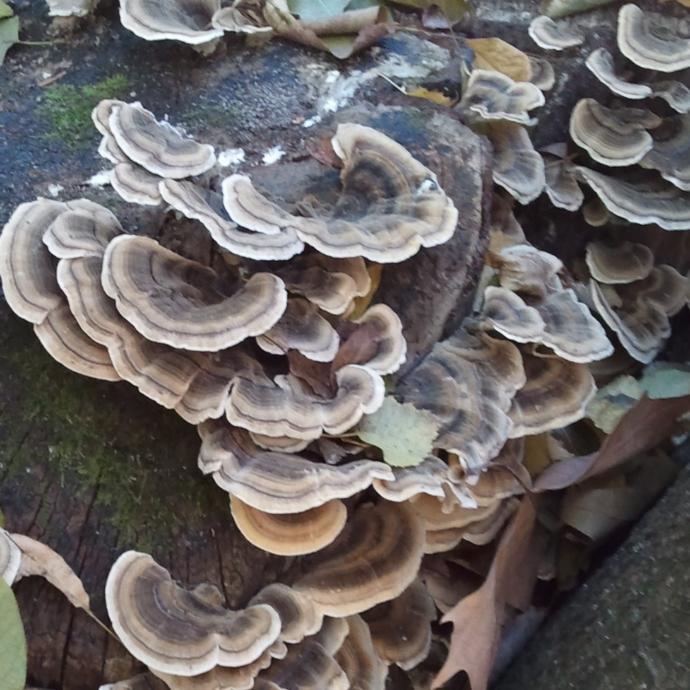
Turkey Tail
Scientific name: Trametes versicolor
Synonyms: Turkey Tail, Polypore, Coriolus versicolor, Yun Zhi, Kawaratake
Distribution and Habitat in Nature: The Turkey Tail mushroom is a common saprobiontic wood dweller or weak parasite. Its primary substrate in Central Europe is the European Beech, though it can also be found on Oak, Birch, Common Hazel, and Willow. Additionally, it can grow on many other broadleaf trees and occasionally on conifers. The species is found on stumps, wood piles, fallen logs, branches, and twigs. It is present in all forest types in Central Europe and can also be found outside of forests if suitable substrate is available.
Ingredients: The Turkey Tail is a medicinal mushroom rich in vital substances that is traditionally used in naturopathy and mycotherapy. It contains valuable polysaccharides (especially PSK and PSP), which can strengthen the immune system, as well as antioxidant phenols, flavonoids, and beta-glucans. Other ingredients include B vitamins, potassium, copper, and iron. It is considered to be particularly well researched in the field of immunomodulatory and supportive cancer therapy.
Usage: Medicinal mushroom, decoration
Suitable Substrate: Hardwood (Beech, Oak, Birch, Alder, Poplar, Aspen, Elm, Apple, Cherry, and other fruit trees)
It is also used in traditional Chinese medicine and contains polysaccharide peptides and various protein-bound polysaccharides. The butterfly tramete is sometimes used in floristry for decorative purposes.
Cultivation Conditions:
Phase 1: Mycelium Growth
Temperature: 24 - 29°C
Humidity: 90 - 100%
Duration: 14 - 21 days
CO2: >5,000 ppm
Air Exchange: 1 per hour
Light: n/a
Phase 2: Primordia Formation / Initiation of Fruiting
Temperature: 10 - 24 (up to 27) °C
Humidity: 95 - 100%
Duration: 7 - 14 days
CO2: 400 - 800 ppm
Air Exchange: 5 - 7 per hour
Light: 500 - 2,000 Lux
Phase 3: Fruiting and Harvest
Temperature: 18 - 24°C
Humidity: 85 - 90%
Duration: 45 - 70 days
CO2: 500 - 1,000 ppm
Air Exchange: 5 - 7 per hour
Light: 500 - 2,000 Lux