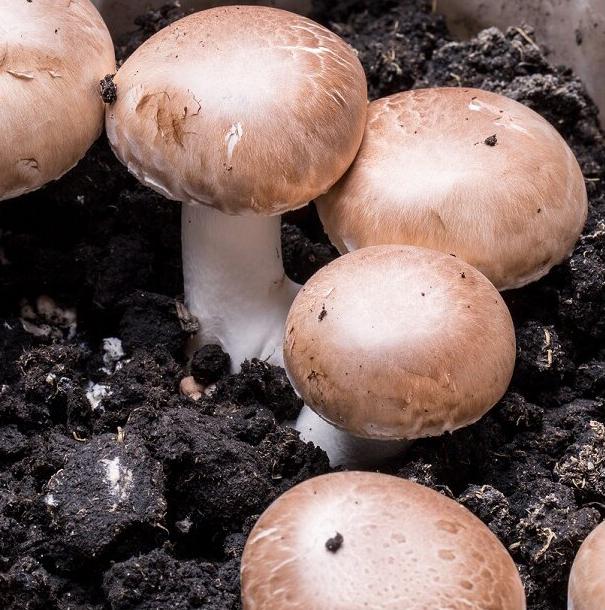
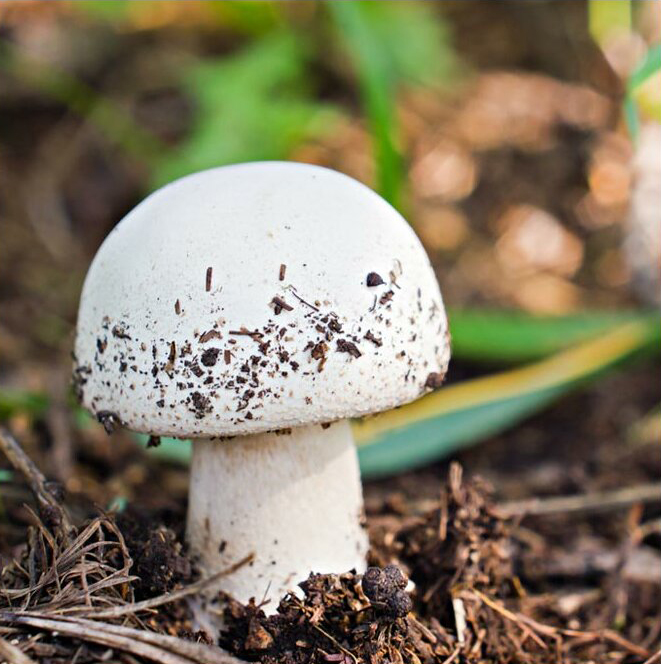
Button mushroom
Various strains available
Scientific name: Agaricus
bisporus
Synonyms: White mushroom,
Cremini mushroom, Chestnut mushroom, Portobello mushroom, Baby bella
Distribution and habitat in nature: Like all members of the Agaricus genus, the cultivated mushroom lives as a saprobiont = secondary decomposer. It thrives on nutrient-rich substrates such as manure or compost. In Central Europe, it is usually found outdoors on compost heaps, in greenhouses in gardens, and in parks. It is also rarely found on forest edges and roadsides. The fruiting bodies appear mainly in spring and summer, less frequently in autumn
Ingredients: It is rich in nutrients, contains B vitamins such as B2, B3, and folic acid, as well as vitamin D2 when exposed to sunlight. It is also low in calories, high in fiber, and contains valuable minerals such as potassium, phosphorus, and iron, as well as antioxidants. Mushrooms are an excellent ingredient in many dishes and a healthy addition to your diet.
Suitable substrate: Mushroom cultivation compost (plus covering soil)
Nutrient-rich substrates made from manure (cattle, horse, chicken, etc.) and compost.
Usage: Edible mushroom, medicinal and vital mushroom, mycorestauration/mycoremediation
The mushroom has a mild, slightly nutty flavor and can be used in many ways, both raw, for example in salads, and cooked. It is low in calories, high in fiber, and contains valuable minerals such as potassium, phosphorus, and iron, as well as antioxidants. The mushroom is an excellent ingredient in many dishes and a healthy addition to your diet.
Taxonomy:
Kingdom: Fungi
Class: Agaricomycetes
Subclass: Agaricomycetidae
Order: Agaricales
Family: Agaricaceae
Genus: Agaricus
Spores: brown, ellipsoid, 5.5 to 8.5 micrometers long, 4 to 6.5
micrometers wide
Breeding conditions:
Phase 1: Mycelium growth
Temperature: 23-25°C
Humidity: 90-100%
Duration: 18-20 days on compost
CO2: >5,000 ppm
Air exchange: 1 per hour
Light: n/a
Phase 2: Primordia formation / initiation of fruiting
(after applying the covering soil)
Temperature: 16-18°C
Humidity: 95-100%
Duration: 12–18 days
CO2: 400–800 ppm
Room air exchange: 5–7 per hour
Light: not required
Phase 3: Fruiting and harvesting
Temperature: 16–18 °C
Humidity: 85–90% (95%)
Duration: 4–7 days
CO2: <1000 ppm
Room air exchange: 5–7 per hour
Light: not required
Harvest waves: every 2 weeks for 2–3 harvest waves