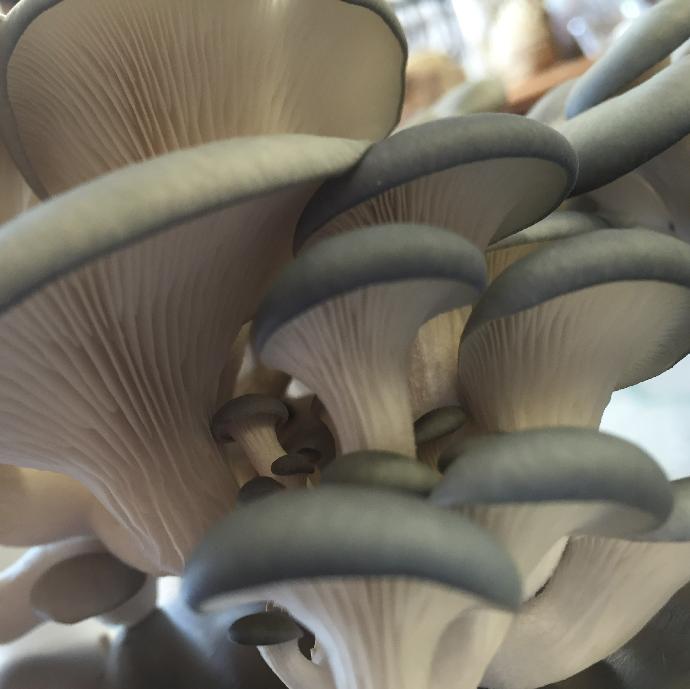
Oyster mushroom
Scientific name: Pleurotus ostreatus
Synonyms:
Tree oyster, Hiratake, Tamogitake
Distribution and habitat in nature: Mainly on diseased and dead deciduous trees, rarely on conifers. Widely distributed throughout the world.
Ingredients: Oyster mushrooms are rich in B complex vitamins such as B1 (thiamine), B2 (riboflavin), B5 (niacin), B6, and B7 (biotin). They also contain folic acid and vitamins C and D (calciferol). A quarter of the dry matter of this mushroom consists of proteins and contains all essential amino acids. Other very important ingredients of Pleurotus are ß-glucans (polysaccharides), pleuran, and lovastatin.
Suitable substrate: Straw, paper, coffee grounds, coffee bean pulp, hardwood (poplar, oak, alder, aspen, maple, birch, ash, beech, willow, elm)
Usage:
Edible mushroom, medicinal mushroom
The oyster mushroom is a very easy-to-grow edible mushroom. The mycelium of this mushroom is very robust, which is why it is one of the most popular cultivated mushrooms. The fruiting bodies reach a diameter of 5–15 cm. The cap is gray-brown to purple, transitioning to a whitish color towards the gills and stem.
Taxonomy:
Class: Agaricomycetes
Subclass: Agaricomycetidae
Order: Agaricales
Family: Pleurotaceae
Genus: Pleurotus
Spores: mostly white to grey, 7.5 - 9.5 x 3 - 4 µ, clamp connections are present
Cultivation conditions:
Phase 1: Mycelium growth
Temperature: 24°C
Humidity: 85 - 95%
Duration: 12 - 21 days
CO2: 5,000 - 20,000 ppm
Air exchange: 1 per hour
Light: n/a
Phase 2: Primordia formation / initiation of fruiting
Temperature: 10 - 15.6°C
Humidity: 95 - 100%
Duration: 3 - 5 days
CO2: <1,000 ppm
Air exchange: 4 - 8 per hour
Light: 1,000 - 1,500 (2,000) lux
Phase 3: Fruiting and harvest
Temperature: 10 - 21°C
Humidity: 85 - 90%
Duration: 4 - 7 days
CO2: <1,000 ppm
Room air changes: 4 - 8 per hour
Light: 1,000 - 1,500 (2,000) lux