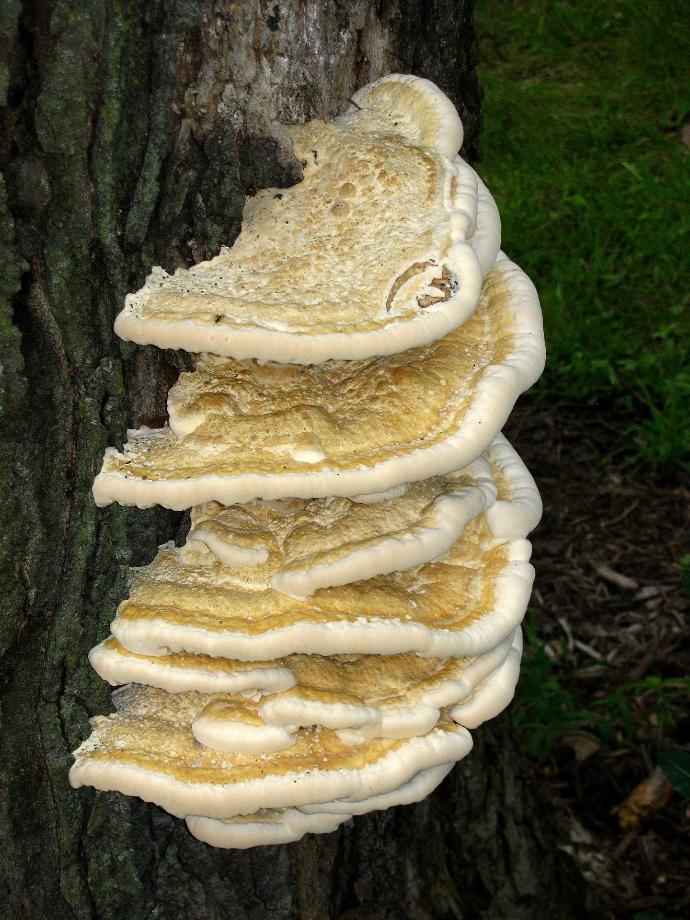
Huaier
Scientific name: Vanderbylia robiniophila
Synonys: Trametes
robiniophila, Huai’er
Distribution and habitat in nature: It acts as a weak parasite and secondary decomposer (causing white rot), primarily affecting locust species, as well as the Japanese pagoda tree (Styphnolobium japonicum) and the American hackberry (Celtis occidentalis). It breaks down lignin, contributes to humus formation, and grows preferentially on locust wood. Like many polypores, Huaier does not form a stem but grows directly on wood as a flat, semicircular fruiting body with a porous underside, usually close to the ground. Its distribution is limited to the warm, humid regions of Asia and North America.
Ingredients: PS-T (polysaccharide–protein complex), other polysaccharides, structural proteins, phenolic compounds, trace elements
Suitable Substrate: Grains; hardwood substrates of various locust species, e.g. Robinia pseudoacacia, Japanese pagoda tree (Styphnolobium japonicum), and American hackberry (Celtis occidentalis)
Usage: Medicinal mushroom,
In classical TCM texts, Huaier is assigned to the spleen and liver functional systems. It is used for severe, long-standing illnesses and helps reduce pathological hardenings. Even today, Huaier is primarily associated with serious chronic diseases—particularly in the field of oncology.
Taxonomie:
Kingdom: Fungi
Division: Basidiomycota
Class: Agaricomycetes
Order: Polyporales
Family: Polyporaceae
Genus: *Vanderbylia*
Species: *Vanderbylia robiniophila*
Cultivation conditions::
No precise cultivation conditions have yet been established. These are currently the subject of our research and substrate development.
Picturecopyright: Kithsun Andrew über Mushroom Observer