Production of spore syringes
(Difficulty level 2 - Advanced)
Spore syringes contain spores dissolved in sterile water, which are used to inoculate substrates via an injection needle.
Working with spore syringes has proven particularly useful for amateur mycologists, as even in less sterile environments there are
hardly any losses due to contamination.
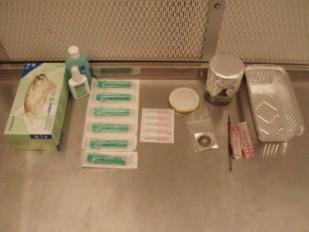
Recommended accessories:
- Spore print
- Inverted jar (sterilisable!) with 2 lid
- Scalpel with sterile blades
- Empty syringes and needles
- Latex gloves
- Face mask and hairnet
- Filter disc
- Surface disinfectant (recommended: Bacillol)
- Hand disinfectant
- Water
- Glove bag (better: sterile workspace with HEPA filter)
We recommend using approximately 100 ml of water per jar and one spore print. Two lids are used: one without a hole for shaking and mixing the spores in the jar, and one with a hole (approximately 1 cm in diameter) for later needle insertion.
Fill the jars with water (up to 2/3 full) and screw on the lid with the hole. Wrap this lid with aluminum foil. The jar with the perforated lid and the intact lid, which is also wrapped in aluminum foil, should be sterilized for 30 minutes.
For sterilization, we recommend using a pressure cooker. The sterilization time starts only when the pressure indicator on the cooker reaches the highest level (for household pressure cookers) or 121°C / 250°F / 15 psi / 1.05 bar (for professional cookers). After the sterilization time has elapsed, place the cooker in a clean area to cool down, ideally in front of a HEPA filter (sterile airflow). During cooling, you can place a cloth soaked in alcohol or a 10% chlorine solution over the cooker to filter the air entering the cooker.
Only open the lid when the pressure inside the cooker has dropped to zero. If the pressure falls below zero, place the cloth soaked in alcohol or 10% chlorine solution over the intake valve – the vacuum will draw unsterile air into the cooker. The cloth filters the air again, reducing the risk of contamination. Please thoroughly clean and disinfect your hands and forearms, and consider using latex gloves. Place the jars and lids in front of a HEPA filter or in a glove box until they are cooled. Once they have cooled to room temperature (below 30°C), they can be further processed.
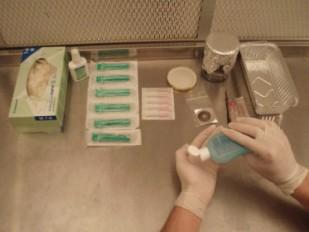
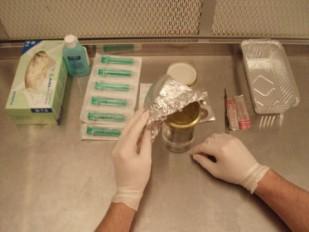
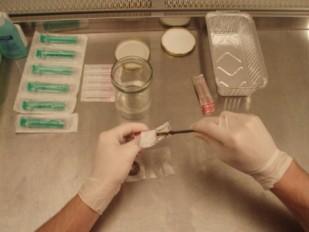
To minimize contamination risk, it is crucial to maintain sterile conditions! Please use a fresh, sterile scalpel blade for each spore print.
Before starting work, thoroughly wash your hands, forearms, and upper arms with hot water and soap. Clean and disinfect the work surface with a surface disinfectant. Next, put on a hairnet, face mask, and gloves. Just before starting work, disinfect the gloves with a hand sanitizer, observing the recommended contact time.
In a clean, preferably sterile room or in a glove box, use a scalpel to scrape the spores from the prints into the water. Work quickly and cleanly, handling the spore print only by its edge where no spores are attached.
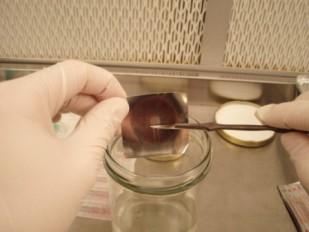
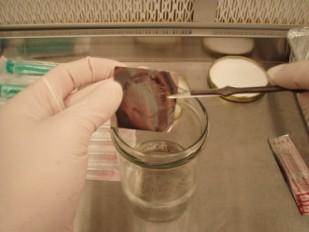
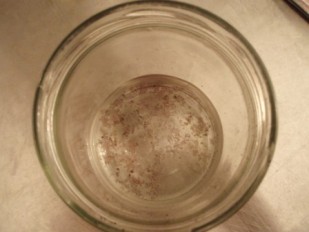
The spores are scraped from the print into the water.
Once the spores are scraped into the glass, seal the glass with the lid without the hole and shake well to evenly distribute the spores in the water. To fill the syringes, replace the lid with the one with the hole. Remove the needle's protective cap and insert the needle through the hole into the spore solution to draw it up. It is very important that the needle is not touched with your hands. Ideally, replace the protective cap on the needle immediately after drawing up the solution.
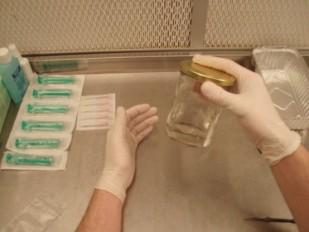
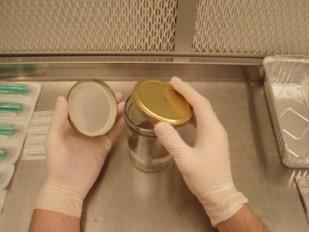
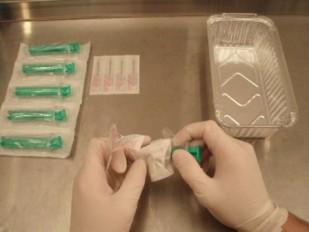
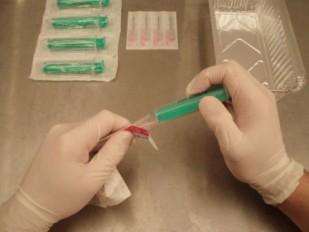
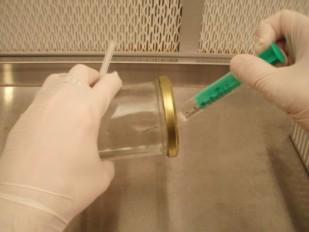
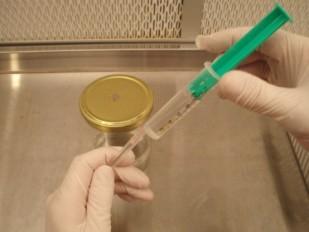
We recommend sealing the spore syringes in an airtight zip-lock bag. Stored in a cool place (max. 20°C) and kept in the dark, they remain viable for at least 1 year.
To test their viability, place a few milliliters (1 to 2 drops) onto an agar plate in a petri dish. Depending on the mushroom species, mycelium growth should begin within a few days to a week (see also the guide "Mycelium Cultivation from Spores")