Our substrates are produced FRESH for you, so the production time is approximately 3 - 6 weeks.
Summer Sale from July 10–26: Up to 40% off Vital mushroom products! (Powder Capsules, Liquid Extracts, Coffee)
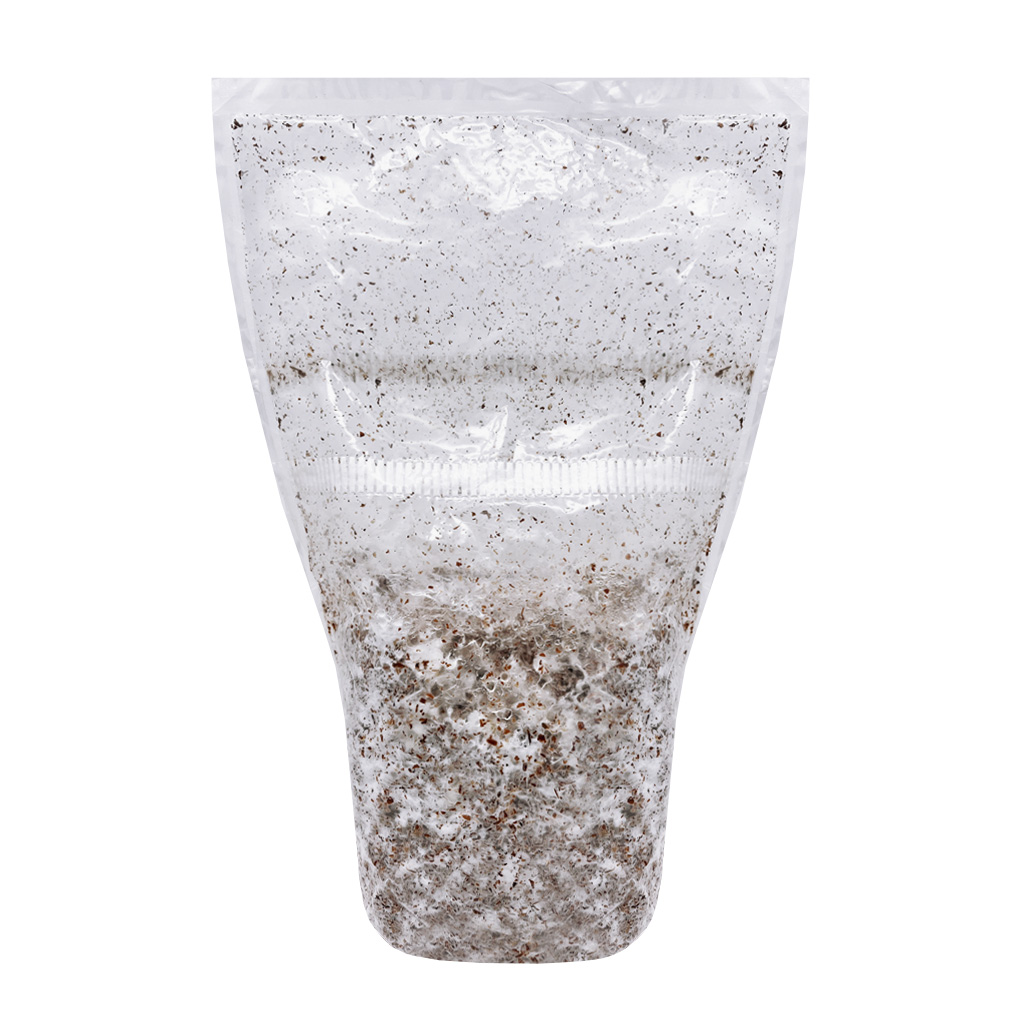
Azurescens Astoria Ossip - Mycorestaurationbag
spawn for mycorestauration
IN STOCK - we ship immediately
Quantity discount:
from 3 pcs.
from 6 pcs.
from 30 pcs.
from 100 pcs.
Stately bald head - Psilocybe Azurescens Astoria Ossip-Strain - Mycorestaurationbag
Synonyms: Magic Mushroom, Blue Angels, Blue Flying Saucer Mushroom, Azzies, Indigo Psilocybe
Toxic! Not for consumption! Originally discovered in Astoria, Oregon, USA, the blue-staining woodlover was initially named Psilocybe astoriensis. Due to its tendency to turn azure blue upon injury, it is now also known as Psilocybe azurescens.
As a wood-decay fungus, it plays a significant role in mycorestoration, as psilocybe mushrooms are among the few species capable of decomposing significant chemical pollutants.
Its cap is conical in young specimens, later flattening, ochre-yellow to chestnut-brown, and 3 - 10 cm in size. The gills are adnate, densely spaced, ascending at the base, spotted, and darken upon injury. The stem is naturally white, 9 0 20 cm long, and a few millimeters thin, thickening towards the base, often curved.
The blue-staining woodlover has no distinct odor, and its taste is extremely bitter.
Natural occurrences of the blue-staining woodlover are found in various parts of Central Europe. Due to its constituents, harvesting, possessing, and selling it for human consumption are prohibited in many countries.
Mushroom patch is always made fresh on demand. Production time: 3 - 6 weeks.
This product is fresh produce and should be processed immediately after delivery.
If the product is not processed immediately, it can be stored in refrigeration at 4° Celsius for a maximum of 2 weeks.
Please consider these timings when placing the order.
Suitable cultivation methods: wood logs, mushroom patch. - also for mycorestauration, spawn bags for indoor greenhouse
Suitable Substrates: straw, paper, coffee pulp or fruit flesh, hardwood
Suitable woods are maple, birch, beech, oak, alder, ash, aspen, poplar, elm and willow.
This breeding strain bears fruit when grown outdoors in late autumn at the first frost.
You receive mushroom spawn colonised by mushroom mycelium based on organic raw materials (wood, rye bran from organic farming) in bags specially designed for sterilisation.
Depending on the type of mushroom, they are available in the following sizes:
1 autoclave bag with approx. 1 litre (500 grams) is suitable for inoculation and for propagation over 4 - 8 weeks in sterilised wood substrate before inoculating the mushroom bed (see instructions).
1 autoclave bag with approx. 6 litres of mushroom spawn is suitable for inoculating an 80 x 80 cm mushroom bed.
Mycological restoration using mushroom beds:
Some types of fungi are suitable for breaking down these toxins and removing them from the environment.
To do this, fungal mycelium from the relevant types of fungi is distributed in the contaminated soil and mixed with a suitable culture medium in order to cover a large area of the pollutant source. The mycelium strands grow through the soil. They absorb individual toxins directly or break them down into their components, rendering them harmless.
The fungus absorbs the toxins into its fruiting bodies. These must be harvested at the end of the life cycle and disposed of properly.
The areas of application for this type of fungus are
- Dimethylmethylphosphonates (DMMP), which are contained in neurotoxins such as VX, soman and sarin,
- Persistent organic hydrogens from flame retardants, fuel additives and insecticides such as DDT
- Bacteria such as Escherichia coli and other strains,
- nitrate- and phosphorus-bound toxins, some of which are used intensively on agricultural land.
Sources:
STAMETS, La Dena Che'. Best Mycorestoration Practices for Habitat Restoration of Small Land Parcels. 2012.
STAMETS, Paul. Mycelium running: how mushrooms can help save the world. Ten speed press, 2005, pp. 85 - 113.
Note on product safety:
The fruiting bodies of this genus are not suitable for human or animal consumption. Toxicity: Toxic.
In some countries the delivery of this product is only possible after presentation of an import licence, for example Finland, California, Russia, Switzerland, Turkey and others. Please inform yourself about the regulations in your country before ordering.
Taxonomy:
Class: Agaricomycetes
Subclass: Agaricomycetidae
Order: Mushroom-like (Agaricales)
Family: Strophariaceae (Strophariaceae)
Genus: Baldcap (Psilocybe)
Species: Stately bald cap (Psilocybe azurescens)
Spores: elliptical shape, 9 - 13.5 × 5 - 8 µ, four-spored bastids
Breeding conditions:
The exact breeding conditions are still at the research stage.