Our substrates are produced FRESH for you, so the production time is approximately 3 - 6 weeks.
Buy more, save more—check out our volume discounts! (Visible in your shopping cart at the latest!)
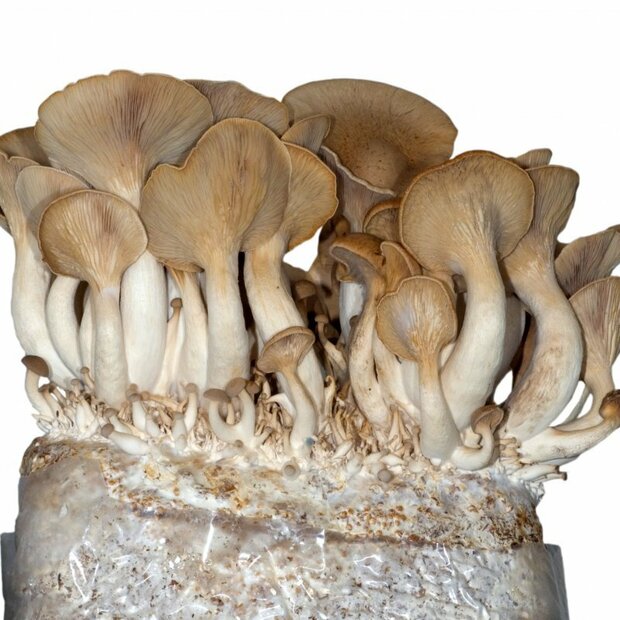
Organic King Oyster Mushroom - P. eryngii - Mushroom Patch
for organic mushroom cultivation
Quantity discount:
from 3 pcs.
from 6 pcs.
from 30 pcs.
from 100 pcs.
Organic King Oyster Mushroom - Pleurotus eryngii - Mushroom patch
Synonyms:
King Trumpet Mushroom, Boletus of the Steppes, Xìng Xào Gu, Eringi, Saesongi Peoseot
The king oyster mushroom is characterised by its delicate flavour and firm flesh. The Eryngii is a delicious edible mushroom that can be used in a similar way to porcini mushrooms.
The fruiting bodies have a diameter of 3 - 10 cm, the stalk is also 3 - 10 cm long. In particularly good conditions, the king oyster mushroom can reach a weight of up to 300 g each.
The freshly harvested fruiting bodies can be kept for up to 2 weeks if refrigerated!
This fresh product is prepared fresh for you to order. The production time is around 3 - 6 weeks.
The mushroom spawn should be processed immediately after delivery.
If the product cannot be processed immediately, it can be stored in the refrigerator at 4 °C for up to 2 weeks.
We recommend that you plan for this when ordering.
Suitable cultivation methods:
straw bales, wood logs, mushroom patch
- also for mycological restoration spawn bags for indoor greenhouse
Suitable substrates: straw,
hardwoodSuitable woods: poplar, oak, elder, aspen, acorn, birch, ash, beech, willow, elm
Outdoors: this strain fruits in late summer and autumn
You receive mushroom spawn colonised by mushroom mycelium based on organic raw materials (wood, rye bran from organic farming) in bags specially designed for sterilisation.
Depending on the type of mushroom, they are available in the following sizes:
1 autoclave bag with approx. 1 litre (500 grams) is suitable for inoculation and for propagation over 4 - 8 weeks in sterilised wood substrate before inoculating the mushroom bed (see instructions).
1 autoclave bag with approx. 6 litres of mushroom spawn is suitable for a mushroom bed measuring 80 x 80 cm.
Mycological restoration using mushroom beds:
Some types of fungi are suitable for breaking down these toxins and removing them from the environment.
To do this, fungal mycelium from the relevant types of fungi is distributed in the contaminated soil and mixed with a suitable culture medium in order to cover a large area of the pollutant source. The mycelium strands grow through the soil. They absorb individual toxins directly or break them down into their components, rendering them harmless.
The fungus absorbs the toxins into its fruiting bodies. These must be harvested at the end of the life cycle and disposed of properly.
The areas of application for this type of mushroom are
- Dimethylmethylphosphonates (DMMP), which are contained in neurotoxins such as VX, soman and sarin,
- Dioxin, also known as Seveso poison, which was used extensively as a weedkiller for a long time,
- Bacteria such as Escherichia coli and other bacterial strains.
Sources:
STAMETS, La Dena Che'. Best Mycorestoration Practices for Habitat Restoration of Small Land Parcels. 2012.
STAMETS, Paul. Mycelium running: how mushrooms can help save the world. Ten speed press, 2005, p. 85 - 113.
Taxonomy:
Class: stander fungi (Basidiomycetes).
Subclass: cap fungi (Agaricomycetidae)
Order: Leaf fungi (Agaricales)
Family: Pleurotaceae (mushroom family)
Genus: Side mushrooms (Pleurotus)
Species: Herbaceous mushroom
Spores: whitish, 7 - 9.5 µ x 3.5 µ
Growing conditions:
Phase 1: Mycelial growth
Temperature: 24°C
Humidity: 90 -95
Duration: 12 - 16 days
CO2: 5,000 - 20,000 ppm
Fresh air exchange: 1 per hour
Light: n/a
Phase 2: Primordia formation / Fruiting initiation
Temperature: 10 - 15°C
Humidity: 95 - 100%
Duration: 4 - 5 days
CO2: 500 - 1,000 ppm
Fresh air exchange: 4 - 8 per hour
Light: 500 - 1000 lux
Phase 3: Fruiting and harvesting
Temperature: 15 - 21 °C
Humidity: 85 - 90%
Duration: 4 - 8 days CO2: <2000 ppm
Fresh air exchange: 4 - 5 per hour
Light: 500 - 1000 lux
Harvesting cycle: 2 - 3 crops, 7 - 14 days apart, for 45 - 55 days