Our substrates are produced FRESH for you, so the production time is approximately 3 - 6 weeks.
Buy more, save more—check out our volume discounts! (Visible in your shopping cart at the latest!)
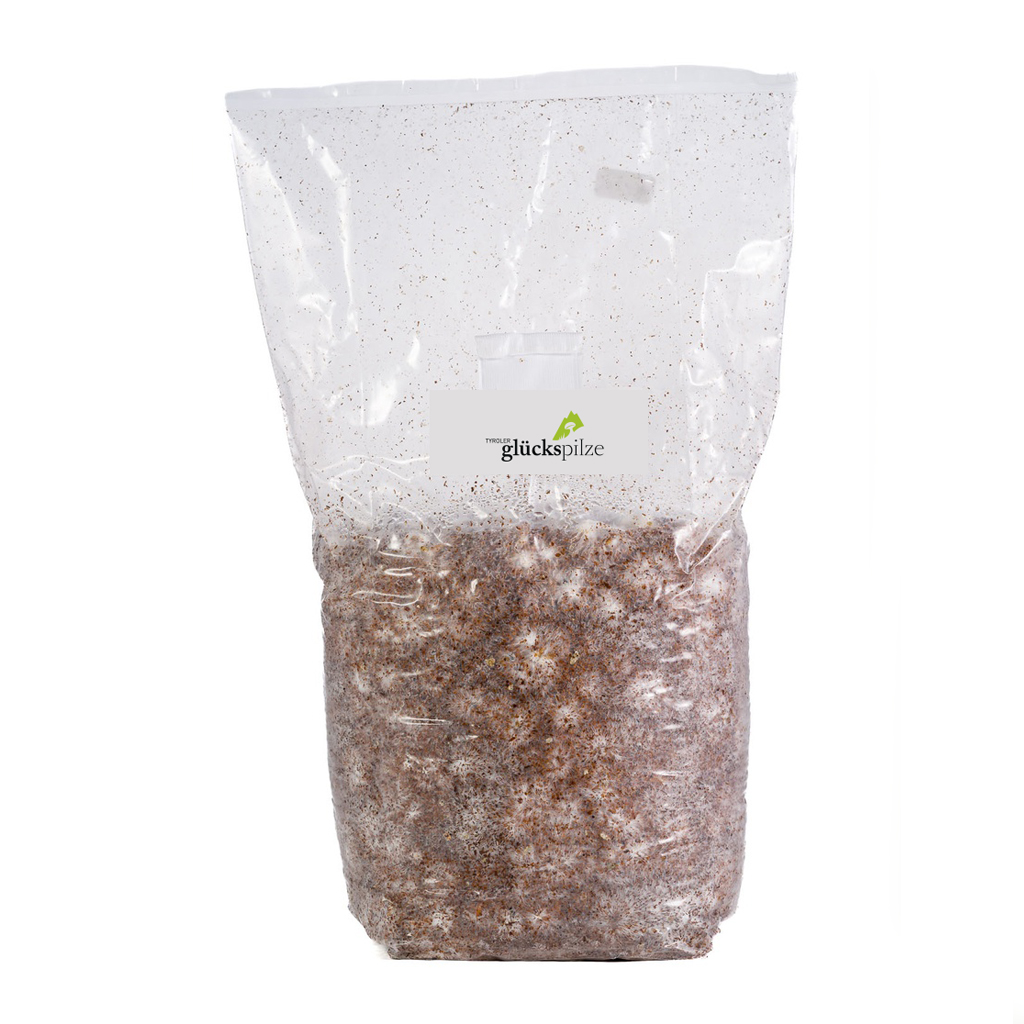
Organic Lion´s Mane - Hericium erinaceus - Sawdust Spawn
for organic mushroom cultivation
Quantity discount:
from 3 pcs.
from 6 pcs.
from 30 pcs.
from 100 pcs.
Organic Lion's Mane- Hericium erinaceus - Sawdust-Spawn
Synonyms: Monkey's head, Sheep's head, Bear's head, Old Man's Beard, Hedgehog mushroom, Yamabusitake, Pom-Pom blanc, hóu tóu gu (chi: monkey's head), nam dau khi, Norugongdengi-beoseot
The lion's mane beard owes its name to its unusual shape. It is roundish-oval or heart-shaped and covered on the outside with many densely arranged long spines. The Chinese use this apt name because of this. However, it is also known there as the monkey's head mushroom, as the fruiting body is reminiscent of a hairy monkey's head.
The lion's mane spiny beard is a popular and excellent edible mushroom in China. Its unique flavour and extremely decorative, coral-like appearance make it a much sought-after delicacy. It is one of the few mushrooms that have a strong lobster flavour when cooked.
In Europe, the hedgehog spiny beard is not very well known, although it is native to parts of the continent, including Austria. In the wild, this mushroom can be found in deciduous forests in Europe, North America and Asia (especially China and Japan). The hedgehog spikenard is rich in potassium, zinc, iron, germanium, selenium, phosphorus and contains all essential amino acids as well as polysaccharides and polypeptides.
Sawdust spawn is always made fresh on demand. Production time: 3 - 6 weeks.
This product is fresh produce and should be processed immediately after delivery.
If the product cannot be processed immediately, it can be stored in refrigeration at 4ºC for a maximum of 2 weeks.
Please consider these timings when placing the order.
Suitable cultivation methods:
wood logs, spawn bags for indoor greenhouse
Suitable substrate: hardwood
Suitable woods: maple, birch, beech, oak, alder ash, aspen, poplar, elm and willow
Outdoors: this strain produces fruiting bodies in summer
You receive fully colonised sawdust spawn based on organic raw materials (wood, rye bran from organic cultivation) in bags specifically suitable for sterilisation.
Information for cultivation on straw and substrate:1 autoclave bag with app. 3 litres of mushroom spawn is suitable for inoculating 1 straw bale or 5 - 15 substrate bags1 autoclave bag with app. 6 litres of mushroom spawn is suitable for inoculating 2 straw bales or 10 - 30 Substrate bags.
Information for cultivation on wood:
When using our equipment
(inoculation stick or hand inoculator) the sawdust spawn bags are suitable for:
1 autoclave bag with app. 3 litres of mushroom spawn is suitable for inoculating 12 - 15 linear metres of wood
1 autoclave bag with app. 6 litres of mushroom spawn is suitable for inoculating 25 - 30 linear metres of wood.
For quantities of 10 logs or more, inoculating with sawdust spawn ins usually more efficient than working with spawn dowels. The raw materials sawdust and wood chips are by-products and therefore more cost effective and sustainable than specially manufactured wooden dowels. As a result, sawdust spawn can also be produced cost-effectively in large quantities. Sawdust spawn is suitable for the drilling method and the cut inoculation method.
The expected yield is up to 10% of the fresh wood weight, divided into several harvest waves over a period of 3 - 5 years. When utilising the drilling method we recommend using a mushroom drill and an inoculation stick or hand inoculator.
Suitable for beginners.
Large quantities for commercial mushroom cultivation available upon request.
Taxonomy:
Class: stander fungi (Basidiomycetes).
Subclass: cap fungi (Agaricomycetidae)
Order: Brittle leaves (Russulales)
Family: Spiny beard fungi (Hericiaceae)
Genus: Spiny bearded (Hericium)
Species: Hericium erinaceus (hedgehog spiny beard)
Spores: white, elliptical, smooth to slightly rough; 5.5 - 7 x 4.5 - 5.5 µ
Growing conditions:
Phase 1: Mycelial growth
temperature: 21-24°C
Humidity: 95-100%.
Duration: 10 - 14 days
CO2: >5,000 - 40,000ppm
Fresh air exchange: 0 - 1 per hour
Light: n/a
Phase 2: Primordia formation / Fruiting initiation
Temperature: 10 - 15.6 °C
Humidity: (85) 90 - 95%
Duration: 4 - 5 days
CO2: 500 - 1000 ppm
Fresh air exchange: 5 - 8 per hour
Light: 500 - 1,000 lux
Phase 3: Fruiting and harvest
Temperature: 18 - 24°C
Humidity: (85) 90 - 95%.
Duration: 4 - 5 days
CO2: 500 - 1000 ppm
Fresh air exchange: 5 - 8 per hour
Light: 500 - 1,000 lux
Harvesting cycle: 2 crops, 14 days apart