Our substrates are produced FRESH for you, so the production time is approximately 3 - 6 weeks.
Buy more, save more—check out our volume discounts! (Visible in your shopping cart at the latest!)
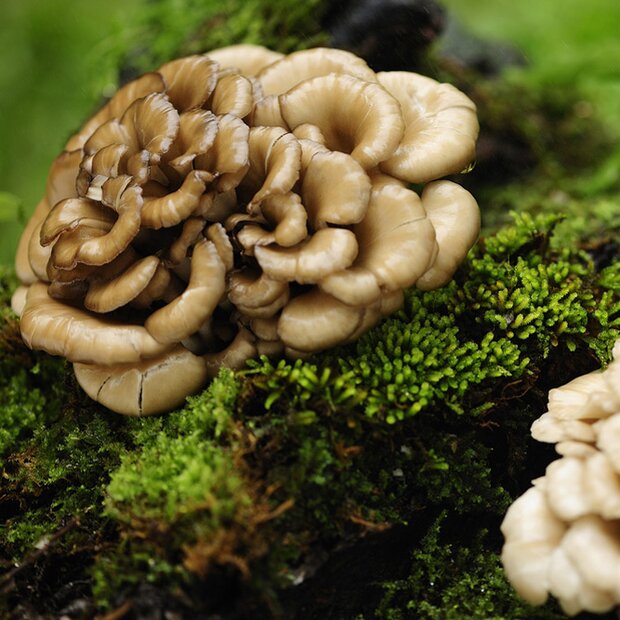
Organic Maitake - Grifola frondosa - Mushroom Patch
for organic mushroom cultivation
Quantity discount:
from 3 pcs.
from 6 pcs.
from 30 pcs.
from 100 pcs.
Organic Maitake- Grifola frondosa - Mushroom patch
Synonyms:
Ram's head, Sheep's head, Signorina mushroom, Maitake, Kumotake, Huai Su Gu
The Maitake
was already considered a very special species in Asia several centuries ago. One reason for this is its unusual bushy shape, which enables the mushroom to adapt particularly well to its surroundings and thus provide it with excellent camouflage. Another is that it was considered so valuable due to its ingredients that the places where it was found were kept strictly secret by collectors. Today, maitake is known in Asia, Europe and America as a delicious, fleshy edible mushroom that is characterized by its high nutritional value. As a result, this mushroom is also arousing great interest in the pharmaceutical industry and has been a valuable object of research in Korean, Japanese and American studies for several years.
The fruiting bodies have a brownish to dark grey color. Many overlapping caps with a diameter of 2 - 10 cm sprout from each mushroom stalk. The young fruiting bodies taste particularly delicious. Mature maitake can be dried and prepared as tea. Under particularly good conditions, Grifola frondosa can produce fruiting bodies of 500 g and more.
The rattling sponge contains many polysaccharides such as beta-glucan, grifolin and grifolan as well as large amounts of ergosterol and provitamin D.
Mushroom patch is always made fresh on demand. Production time: 3 - 6 weeks.
This product is fresh produced and should be processed immediately after delivery.
If the product is not processed immediately, it can be stored in refrigeration at 4° Celsius for a maximum of 2 weeks.
Please consider these timings when placing the order.
Suitable cultivation methods:
wood logs, mushroom patch - also for mycological restoration, spawn bags for indoor greenhouse
Suitable substrate: paper, coffee grounds, pulp from coffee beans, hardwood
Maple, birch, beech, oak, alder, ash, aspen, poplar, elm and willow.
This breeding strain bears fruit when grown outdoors in late summer to early fall.
You receive mushroom spawn colonized by mushroom mycelium based on organic raw materials (wood, rye bran from organic farming) in bags specially designed for sterilization.
Depending on the type of mushroom, they are available in the following sizes:
1 autoclave bag with approx. 1 liter (500 grams) is suitable for inoculation and for propagation over 4 - 8 weeks in sterilized wood substrate before inoculating the mushroom bed (see instructions).
1 autoclave bag with approx. 6 liters of mushroom spawn is suitable for of a mushroom bed measuring 80 x 80 cm.
Mycological restoration using a mushroom bed:
Some types of fungi are suitable for breaking down these toxins and removing them from the environment.
To do this, fungal mycelium from the relevant types of fungi is distributed in the contaminated soil and mixed with a suitable culture medium in order to cover a large area of the pollutant source. The mycelium strands grow through the soil. They absorb individual toxins directly or break them down into their components, rendering them harmless.
The fungus absorbs the toxins into its fruiting bodies. These must be harvested at the end of their life cycle and disposed of properly.
The areas of application of the rattling sponge are
- Polychlorinated biphenyls (PCBs), which are found in plasticizers, insecticides and additives.
Sources:
STAMETS, La Dena Che'. Best Mycorestoration Practices for Habitat Restoration of Small Land Parcels. 2012.
STAMETS, Paul. Mycelium running: how mushrooms can help save the world. Ten speed press, 2005, p. 85 - 113.
Taxonomy:
Class: Basidiomycetes (Basidiomycetes)
Subclass: Cap fungi (Agaricomycetidae)
Order: Pore fungi (Polyporales)
Family: Giant spore fungi (Meripilaceae)
Genus: Rattling sponges (Grifola)
Species: Grifola frondosa
Spores: white, slightly elliptical, smooth and glassy; 6 - 7 x 3.5 - 5 µ
Cultivation conditions:
Phase 1: Mycelium growth
Temperature: 21 - 24 °C
Humidity: 95 - 100 %
Duration: 14 - 30 days
CO2: 20,000 - 40,000 ppm
Room air exchange: 0 - 1 per hour
Light: n/a
Phase 2: Primordia formation
Temperature: 10 - 15.6 °C
Humidity: 95 %
Duration: 5 - 10 days
CO2: 2,000 - 5,000 ppm
Room air exchange: 4 - 8 per hour
Light: 100 - 500 lux
Phase 2: "Frond" formation
Temperature: 10 - 15.6 °C
Humidity: 90 - 95 %
Duration: 10 - 14 days
CO2: 2,000 - 5,000 ppm
Room air exchange: 4 - 8 per hour
Light: 100 - 500 lux
Phase 3: Fruiting and harvest
Temperature: 13 - 16 °C (18 °C)
Humidity: 75 - 85 %
Duration: 14 - 21 days
CO2: < 1,000 ppm
Room air exchange: 4 - 8 per hour
Light: 500 - 1,000 lux
Harvesting cycle: 2 crops, 3 - 4 weeks apart