Our substrates are produced FRESH for you, so the production time is approximately 3 - 6 weeks.
Buy more, save more—check out our volume discounts! (Visible in your shopping cart at the latest!)
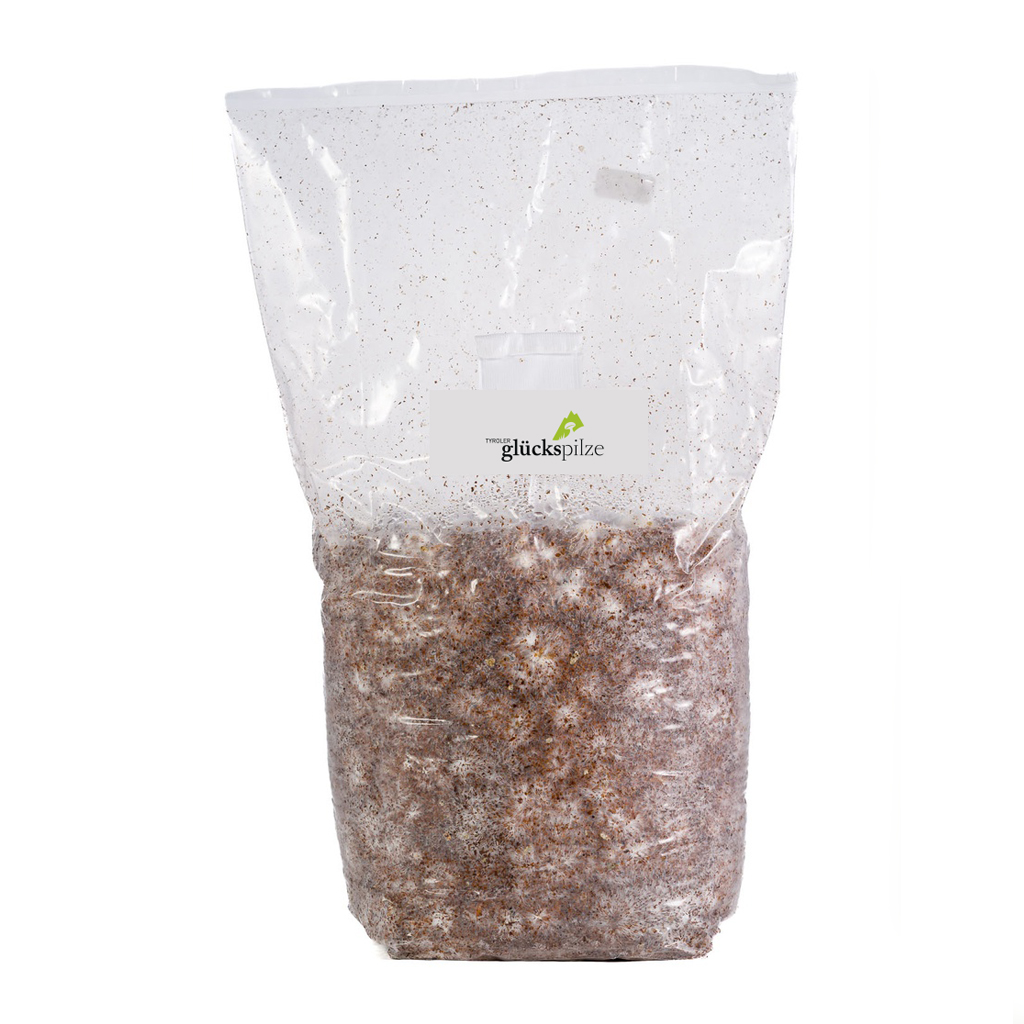
Organic Tree Oyster Mushroom - P. ostreatus - Sawdust Spawn
for organic mushroom cultivation
Quantity discount:
from 3 pcs.
from 6 pcs.
from 30 pcs.
from 100 pcs.
Organic Oyster mushroom- Pleurotus ostreatus - Sawdust spawn
Synonyms: Oyster Mushroom, Hiratake, Tamogitake, Píng Gu, Sadafi, Chippikkoon
Der Tree Oyster Mushroom
is a delicious edible mushroom that is highly easy to cultivate. The mycelium is exceptionally robust, making it one of the most popular cultivated mushrooms.The fruiting bodies of the tree oyster can reach a diameter of 5 - 15 cm. The cap ranges from grey-brown to purple, with the colour transitioning to whitish towards the gills, and the stem.
Pleurotus is rich in B-complex vitamins such as B1 (thiamine), B2 (riboflavin), B5 (niacin), B6 and B7 (biotin). It also contains folic acid and vitamins C and D (calciferol). A quarter of the dry matter of this mushroom consists of proteins and contains all the essential amino acids. Other important components of Pleurotus are beta-glucans (polysaccharides), pleuran and lovastatin.
Sawdust spawn is always made fresh on demand. Production time: 3 - 6 weeks.
This product is fresh produce and should be processed immediately after delivery.
If the product cannot be processed immediately, it can be stored in refrigeration at 4ºC for a maximum of 2 weeks.
Please consider these timings when placing the order.
Suitable cultivation methods:
straw bales, wood logs,
mushroom patch, spawn bags for indoor greenhouse
Suitable substrate:
straw, paper, coffee ground, pulp of coffee beans, hardwood
Suitable woods: birch, beech, oak, alder, aspen, poplar, elm and willow
Outdoors: this strain produces fruiting bodies in late summer to early autumn
You receive fully colonised sawdust spawn based on organic raw materials (wood, rye bran from organic cultivation) in bags specifically suitable for sterilisation.
Information for cultivation on straw and substrate:
1 autoclave bag with app. 3 litres of mushroom spawn is suitable for inoculating 1 straw bale or 5 - 15 substrate bags
1 autoclave bag with app. 6 litres of mushroom spawn is suitable for inoculating 2 straw bales or 10 - 30 substrate bags
Information for cultivation on wood:
When using our equipment
(inoculations stick or hand inoculator) the sawdust spawn bags are suitable for:
1 autoclave bag with app. 3 litres of mushroom spawn is suitable for inoculating 12 - 15 linear metres of wood
1 autoclave bag with app. 6 litres of mushroom spawn is suitable for inoculating 25 - 30 linear metres of wood.
For quantities of 10 logs or more, inoculating with sawdust spawn is usually more efficient than working with Sawdust The raw materials sawdust and wood chips are by-products and therefore more cost effective and sustainable than specially manufactured wooden dowels. As a result, sawdust spawn can also be produced cost-effectively in large quantities. Sawdust spawn is suitable for the drilling method and the cut inoculation method.The expected yield is up to 10% of the fresh wood weight, divided into several harvest waves over a period of 3 - 5 years.When utilising the drilling method we recommend using a mushroom drill and an inoculations stick or a hand inoculator.
Suitable for beginners.
Large quantities for commercial mushroom cultivation available upon request
Taxonomy:
Kingdom: Fungi
Division: Basidiomycota
Class: Agaricomycetes
Order: Agaricales
Family: Pleurotaceae
Genus: Pleurotus
Species: Pleurotus ostreatus
Spores: mostly white to grey, 7.5 - 9.5 x 3 - 4 µ, clamp connections present
Growing conditions:
Phase 1: Mycelial growth
Temperature: 24°C
Humidity: 85 - 95%
Duration: 12 - 21 days
CO2: 5,000 - 20,000 ppm
Fresh air exchange: 1 per hour
Light: n/a
Phase 2: Primorda formation / Fruiting initiation
Temperature: 10 - 15,6°C
Humidity: 95 - 100%
Duration: 3 - 5 days
CO2: <1,000 ppm
Fresh air exchange: 4 - 8 per hour
light: 1,000 - 1,500 (2,000) lux
Phase: Fruiting and Harvest
Temperature: 10 - 21°C
Humidity: 85 - 90%
Duration: 4 - 7 Days
CO2: <1,000 ppm
Fresh air exchange: 4 - 8 per hour
Light: 1,000 - 1,500 (2,000) lux
Harvesting cycle: 2 - 3 crops, 7 - 14 days apart for 45 -55 days