Our substrates are produced FRESH for you, so the production time is approximately 3 - 6 weeks.
Buy more, save more—check out our volume discounts! (Visible in your shopping cart at the latest!)
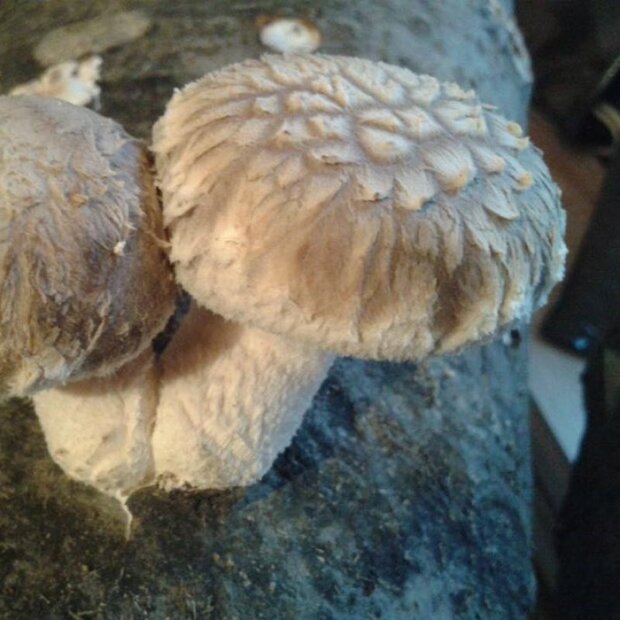
Organic Shiitake - Cold-Strain - Lentinula edodes - Mushroom Patch
for organic mushroom cultivation
Quantity discount:
from 3 pcs.
from 6 pcs.
from 30 pcs.
from 100 pcs.
Organic Shiitake - Lentinula edodes - Cold-Strain - Mushroom patch
Synonyms: Lentinus edodes, Agaricus edodes, Shii-Take, Shaingugu, Hua Gu, Qua Gu, Chinese black mushroom, black forest mushroom
This cultivation strain is a cold-weather shiitake. The special feature of the Shiitake Cold-strain is the relatively low fruiting temperature. It already forms fruiting bodies between 5 - 15 °C (ideally 8 - 10 °C). Of course, it should be borne in mind that growth is slower at low temperatures and the harvest yield is somewhat lower than with other shiitake strains. The Shiitake Cold-Strain is very popular for outdoor cultivation in order to extend the harvest season by a few weeks. The shiitake cold-strain has also proved its worth when grown at higher altitudes.
The Japanese name "shiitake" is made up of "take" (= mushroom) and "shii" (= pasania tree) and literally means "mushroom that grows on the tree". Shiitake is native to Japan, Korea and China and its properties have been known to the population for around 2,000 years.
Its odour is strongly reminiscent of garlic and is due to an ingredient called lenthionine. The shiitake is considered the most popular edible mushroom after the button mushroom.
This fresh product is prepared fresh for you to order. The production time is around 3 - 6 weeks.
The mushroom spawn should be processed immediately after delivery.
If the product cannot be processed immediately, it can be stored in the refrigerator at 4 °C for up to 2 weeks.
We recommend that you plan for this when ordering.
Suitable cultivation methods: wood logs, mushroom patch - also for mycological restoration,
Suitable substrate: Hardwood
Suitable woods: Oak, beech, birch, alder, chestnut, shiia/pasania
This breeding strain bears fruit when grown outdoors in spring and autumn
You receive mushroom spawn colonised by mushroom mycelium based on organic raw materials (wood, rye bran from organic farming) in bags specially designed for sterilisation.
Depending on the type of mushroom, they are available and processed as follows:
1 autoclave bag with approx. 1 litre (500 grams) is suitable for inoculation and for propagation over 4 - 8 weeks in sterilised wood substrate before inoculating the mushroom bed (see instructions).
1 autoclave bag with approx. 6 litres of mushroom spawn is suitable for inoculation a mushroom bed measuring 80 x 80 cm.
Mycological restoration using mushroom beds:
Some types of fungi are suitable for breaking down these toxins and removing them from the environment.
To do this, fungal mycelium from the relevant types of fungi is distributed in the contaminated soil and mixed with a suitable culture medium in order to cover a large area of the pollutant source. The mycelium strands grow through the soil. They absorb individual toxins directly or break them down into their components, rendering them harmless.
The fungus absorbs the toxins into its fruiting bodies. These must be harvested at the end of the life cycle and disposed of properly.
The areas of application for this type of fungus are
- various chemical toxins such as polycyclic aromatic hydrocarbons (PAHs), which are formed in combustion processes, but also
- Polychlorinated biphenyls (PCBs), which are found in plasticisers, insecticides and additives,
- Pentachlorophenaole, which is used in wood preservatives and the textile and leather industries.
Taxonomy:
Class: Agaricomycetes
Subclass: Agaricomycetidae
Order: Agaricales
Family: Marasmiaceae
Genus: Lentinula
Species: Lentinula edodes
Spores: white, oval to ellipsoidal shape, between 5-6.5 x 3-3.5 µ
Growing conditions:
Phase 1: mycelial growth
Temperature: 21 - 27°C
Humidity: 95 - 100%.
Duration: 35 - 70 days
CO2: >10,000 ppm
Room air change: 0 - 1 per hour
Light: 50 - 100 lux
Phase 2: Primordia formation / initiation of fruiting
Temperature: +5 to +15°C (optimal: +8 to +10°C)
Humidity: 95 - 100%.
Duration: 5 - 7 days
CO2: <1,000 ppm
Room air change: 4 - 7 per hour
Light: 500 - 2,000 lux
Phase 3: Fruiting and harvesting
Temperature: +5 to +15°C (optimal: +8 to +10°C)
Humidity: 60 - 80%.
Duration: 7 days
CO2: <1,000 ppm
Room air change: 4 - 8 per hour
Light: 500 - 2,000 lux
Harvest waves: 2 to 3 harvest waves at intervals of approx. 2-3 weeks.